A Day in the Life Working on a VR Production
15 Oct, 2025


2025 Copyright @ Visual Impact.
All Rights Reserved
It's just before sunset in Cape Town, and the city is still bustling with traffic of commuters going home from work. I pull up to the Media24 Building, home to the brand new VR Studio of News24. VR stands for Virtual Reality. From the outside, it looks like any other modern production facility — sleek, glass-fronted, quietly humming with potential. But inside, it's a whole different universe.
We're here to produce a real-time virtual reality selling event for Takealot, one of South Africa's biggest online retailers. It's a hybrid between live broadcast and cinematic storytelling — part advertising, part experience — and it all unfolds inside an ultra-high-resolution LED volume: a virtual world that exists only in light and code.
The pressure is real. This is one of the first productions of its kind in South Africa, and we're shooting it on three Sony Burano cameras, with a background screen boasting the highest resolution in the Southern Hemisphere. Every pixel counts. Every reflection, every lumen of light, every camera angle — all must align perfectly to sell the illusion that what we're seeing on screen is real.
This is where traditional filmmaking meets the future.
Stepping onto the virtual set feels like walking into the holodeck of Star Trek. The LED wall stretches in a sweeping arc around the stage, its seamless panels alive with color and movement. Today, it's displaying a glossy virtual retail environment — a Takealot-branded world where products shimmer and rotate in three-dimensional space.
Around it, the air buzzes with energy: lighting rigs suspended from trusses, camera operators checking focus, crew in the control room tweaking exposure, the DP making last minute adjustments to the lights. Inside the control room, the hum of servers in the background is constant — the heartbeat of the system.
At the center of it all stands a super expensive server, the brain of the operation. This is where the virtual world is rendered in real-time. Every object, reflection, and ray of light is generated instantaneously, responding dynamically to the position of the cameras.
It's a mesmerizing setup — part film studio, part video game, part live broadcast control room.
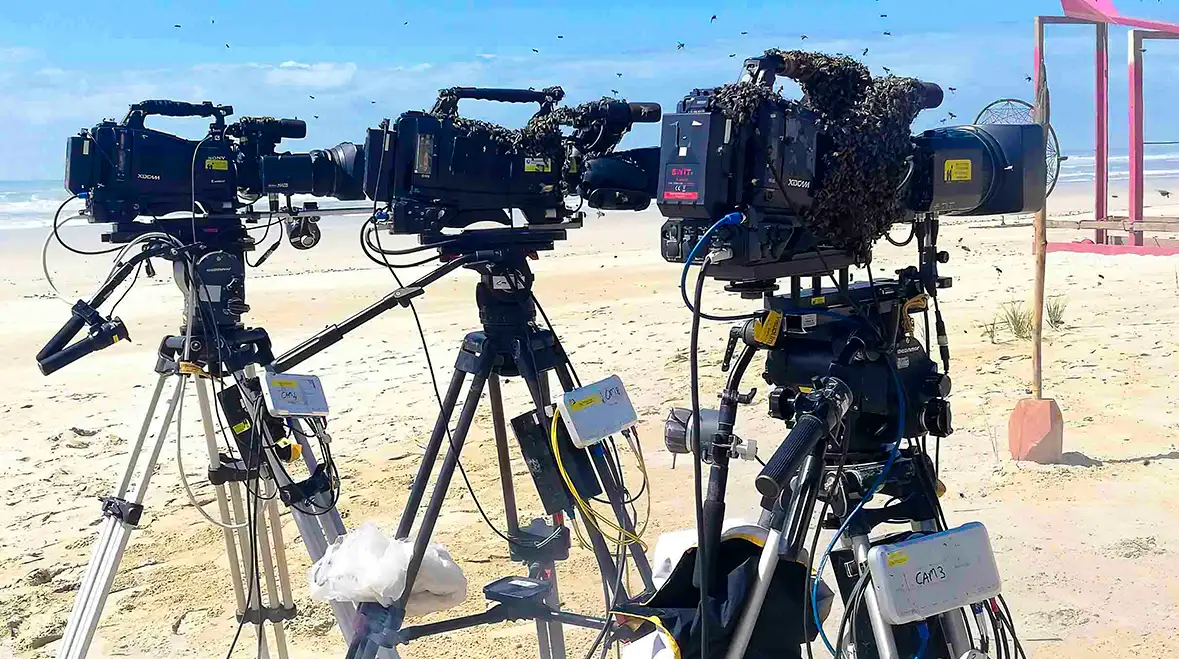
Our three Sony Burano cameras are mounted on tripods at strategic points around the set. Each has a dedicated operator and a live feed running to the control suite. The Burano's full-frame sensor, paired with Sony's exceptional color science, makes it ideal for matching real subjects with the luminous depth of the LED wall. Tonight we'll be streaming a live VR event. This considerably less complicated than XVR.
In XVR (Extended Virtual Reality) studios, the challenge is enormous: each camera must maintain a perfect perspective alignment with the virtual background. Move too far off-axis, and the illusion collapses. The background, which is rendered in parallax, will no longer match the real-world geometry, and the viewer's sense of depth breaks.
To handle this, the cameras are fitted with tracking systems that communicate their position and angle in real-time to the rendering engine. As the camera pans or tilts, the background shifts correspondingly — mimicking the way the human eye perceives depth and space.
It's filmmaking as choreography: every move is calculated, every frame balanced between the tangible and the virtual.
Luckily today we are using the screen as a dynamic backdrop for the live action on the stage only, so there will be no dynamic tracking.
One of the trickiest challenges in any virtual production is lighting. In a traditional studio, lighting is entirely within the cinematographer's control. But in a VR environment, you're balancing two worlds — the physical lighting that illuminates the real subjects, and the virtual lighting that exists within the 3D background.
If the two don't match, the illusion falls apart.
Our LED wall emits light — not just color, but actual luminance that spills onto the set. That can be both a blessing and a curse. On the one hand, it provides beautifully realistic reflections and ambient hues that help integrate the live actors into the digital world. On the other, it complicates exposure.
The lighting intensity of the subjects has to match the brightness of the virtual environment behind them. Too dim, and the actors look flat or disconnected; too bright, and the background loses contrast and detail.
We adjust levels constantly — tweaking the intensity of key lights, bouncing fill from soft panels, and adjusting color temperatures to complement the virtual scene. Every adjustment has a ripple effect.
Shooting with three cameras in a virtual environment adds another layer of complexity. In traditional setups, a multi-camera shoot simply means capturing different angles of the same event. Here, each camera's framing and perspective directly affect how the virtual background is rendered.
Each camera lens sees a slightly different version of the virtual world. This means each one must be carefully composed to avoid visual discrepancies — like misaligned horizon lines or warped geometry.
We spend a lot of time tweaking camera positions and checking composition, guided by the technical director in the control room. Adjustments require both technical and aesthetic intuition — repositioning the camera or subtly tweaking the digital environment so it plays well from all three angles. In our case, we could project three different backgrounds on the screen, at the same time – one for each camera.
The result, when it works, is seamless — a perfectly synchronized multi-camera world that feels tangible and consistent, even though it exists only in light.
At the heart of virtual production lies integration — the fusion of live action and computer-generated imagery in real time. Traditional green screen workflows separate those elements, combining them only in post-production. But in VR, the magic happens live, it is in-camera visual effects, achieved as the footage is being shot.
For our Takealot event, this immediacy was essential. It wasn't just a film shoot — it was a real-time selling event, blending live performance, e-commerce data, corporate identity, and cinematic storytelling. The hosts interacted with products, while real-time graphics updated on the screen in the background.
Every frame had to look flawless, because what we captured was what the audience would see — no safety net in post.
Despite the sleek technology, virtual production is far from plug-and-play. The complexity is immense, and even small issues can cause chain reactions.
One of our biggest challenges was color consistency across cameras. The LED wall emits a pure, polarized light that can sometimes interact unpredictably with the sensor filters in each camera. A minor color cast on one camera can look glaringly obvious when cut together in a multi-cam sequence.
To counter that, technical crew spent hours fine-tuning white balance, matching LUTs, and using color charts under the actual virtual lighting conditions. The Sony Burano's advanced color management tools helped, but it still required constant vigilance — and a lot of patience.
Another hurdle was moiré — those distracting interference patterns that can appear when filming LED screens. Our solution involved adjusting focus, depth of field, and shutter angles, sometimes even slightly defocusing the image to eliminate visible pixel structure.
In XVR productions there is an additional problem that may occur. Render latency issues — the tiny delay between the camera's motion and the corresponding update of the virtual background. Even a few milliseconds can create a perceptible lag that ruins the illusion.
It is a constant balancing act between art and engineering, as every day brings new puzzles to solve.
Beyond the technical brilliance, virtual production opens an entirely new frontier for storytelling. It allows us to create worlds that respond to the story — to build environments that shift, morph, and evolve with the narrative.
For this Takealot project, we weren't just filming a sales pitch; we were building an interactive story-world. The background transformed from one product scene to another — a sleek electronics showroom dissolving into a home décor space, then into a sports gear pavilion. Each transition felt cinematic, guided by motion, light, and music.
The beauty of virtual production is its fluidity. You can change entire worlds in seconds. One moment, your presenters are standing in a futuristic store; the next, they're in a glowing data landscape, surrounded by holographic charts. The boundaries of space dissolve.
But with that freedom comes responsibility. The visuals must always serve the story — not overwhelm it. The art lies in restraint: using the technology to enhance, not distract.
As the day winds down and the last takes are reviewed, I look around the studio — at the glowing wall, the quiet hum of the computers, the cluster of tired but exhilarated crew members — and realize we've witnessed something special.
Virtual production isn't just a new tool; it's a new language of filmmaking. It blurs the line between real and imagined, between live and rendered. It demands both technical precision and creative vision — the mind of an engineer and the soul of a storyteller.
Working on this Takealot VR production at News24's studio reminded me that we're standing at the edge of something transformative. The ability to change background instantly on the screen, during live streaming made this retail event far more dynamic and effective in retaining the attention of potential customers.
Tomorrow, someone will step into another virtual world and push the boundaries a little further, possibly with the aid of AI technology. But for today, as the LED wall fades to black and the studio lights dim, I feel the quiet satisfaction of having helped shape a small part of the future — one frame, one pixel, one story at a time.

Visual Impact South Africa is one of the largest broadcast and film equipment rentals, sales and service companies in South Africa. As part of the international Visual Impact group of companies, we have access to a wide range of equipment and in-house technical expertise.
Visual Impact South Africa, with offices in Johannesburg and Cape Town, provides broadcast and production equipment rentals, workflow solutions, and technical support across Africa, including mobile editing and data management services. The company represents leading global brands such as Sony, ARRI, RED, Canon, and Blackmagic Design, and has facilitated major reality TV productions like I’m a Celebrity, Idols SA, MasterChef SA, and The Bachelor Germany.
Follow Us