A Day in the Life Working on a VR Production
15 Oct, 2025

12 mins read
Reality TV may look spontaneous on screen, but technically it is one of the most demanding production environments in broadcast. Multiple cameras have to stay live for long periods, signal paths have to remain stable, wireless systems have to work across difficult distances, and large volumes of footage have to move safely through production without slowing the shoot.
That is why strong reality production support is not just about renting equipment. It is about engineering a workflow that fits the format, the location, the scale of coverage, the budget, and the production timeline. At Visual Impact, that process starts before filming begins and continues through technical planning, equipment preparation, on-set support, media handling and final delivery.
This guide explains how Reality TV productions are engineered in practice, and why bespoke workflow design matters far more than a generic camera package when a production has to keep moving.
Placeholder link for future articles
Unscripted production creates a unique combination of scale, unpredictability and pressure. A reality format may involve static cameras, handheld roaming cameras, PTZ systems, long cable runs, wireless links, a control room, multiple operators and a fast-turnaround post pipeline all at once.
From an engineering point of view, one of the hardest realities is that downtime is expensive. Tom van Greunen notes that some productions may require support for up to 50 cameras, with picture, control and recording all needing to remain operational continuously. If a fault appears, it has to be resolved quickly so that production is not delayed.
Roedolph Louw adds another layer to the challenge. Modern reality systems are increasingly built around IP and network-managed infrastructure, which means production teams need engineers who understand both traditional broadcast chains and newer IT-based environments. That crossover skill set is in short supply, making robust engineering even more valuable.
Placeholder link for future articles
One of the biggest misunderstandings about reality production is the idea that the workflow starts when the first camera arrives on site. In practice, strong delivery begins much earlier, at the briefing and quote stage.
Zelda Wilson, who works with clients at the beginning of the process, highlights the information that must be clear before an accurate solution can be built. Producers need to define the location, production format, camera style, number of cameras, wireless needs, power setup, lighting and audio requirements, whether a control room is needed, whether technical support should be supplied by Visual Impact, how logistics will be handled, how long the shoot will run, and what final deliverables are expected.
Those details shape everything that follows. They affect transport, signal design, media planning, crew structure, power distribution and budget. This is one of the clearest points of differentiation for Visual Impact: the team starts by understanding the production properly instead of forcing the client into a standard package.
Placeholder link for future articles
Many suppliers can provide cameras, lenses, tripods, lighting and audio gear. The harder and more valuable part is designing a technical workflow that works for a specific production.
Both Tom and Roedolph make the same point in different ways. Visual Impact does not force clients to use a standard system. The company builds around the needs of the show, the layout of the site, the expected distances, the production format and the available budget.
That bespoke approach becomes especially important on reality productions where the requirements are rarely ordinary. A show may need PTZ cameras across a large property, handheld units in fast-moving environments, robust monitoring for directors, and centralised control or switching in a temporary control room. The solution has to be designed, not merely supplied.
Placeholder link for future articles
Pre-production engineering is where risk is reduced. Planning may start months before the shoot begins, especially on larger reality formats.
The process typically includes early technical conversations with the client, building equipment to spec, testing systems before dispatch, site recces, mapping cable paths, deciding where copper can be used and where fibre is required, and planning signal routes from camera positions back to the control environment.
Roedolph describes this phase as signal flow mapping and full technical dry runs. Before day one, the engineering team tests equipment, checks signal integrity and troubleshoots likely failure points so that the always-on nature of reality production is protected. In other words, the calm before the shoot is where many production disasters are prevented.
Placeholder link for future articles
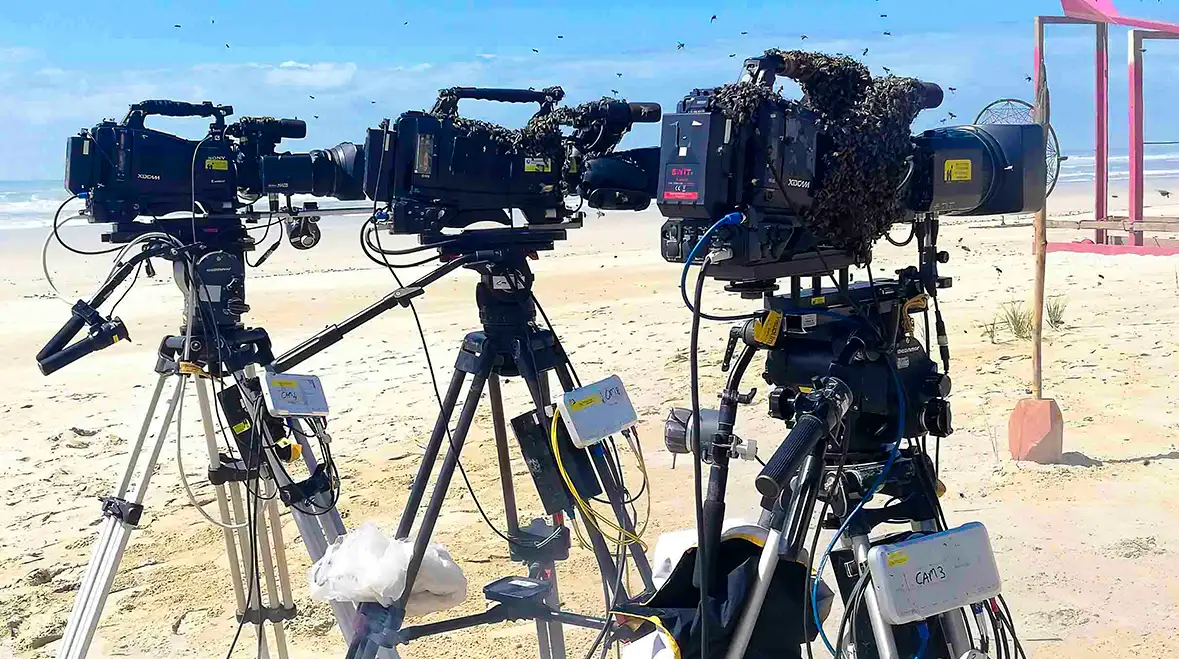
Reality production often combines different types of camera systems within one show. Some cameras are fixed for long observation, some are handheld for mobility and immediacy, and some are PTZ units used where discreet placement or long-distance operation is required.
Tom’s feedback is especially useful here. He notes that many productions require PTZ cameras over long distances, which demands careful planning around fibre and networking. This points to a broader truth: Reality TV camera engineering is as much about infrastructure as it is about image capture.
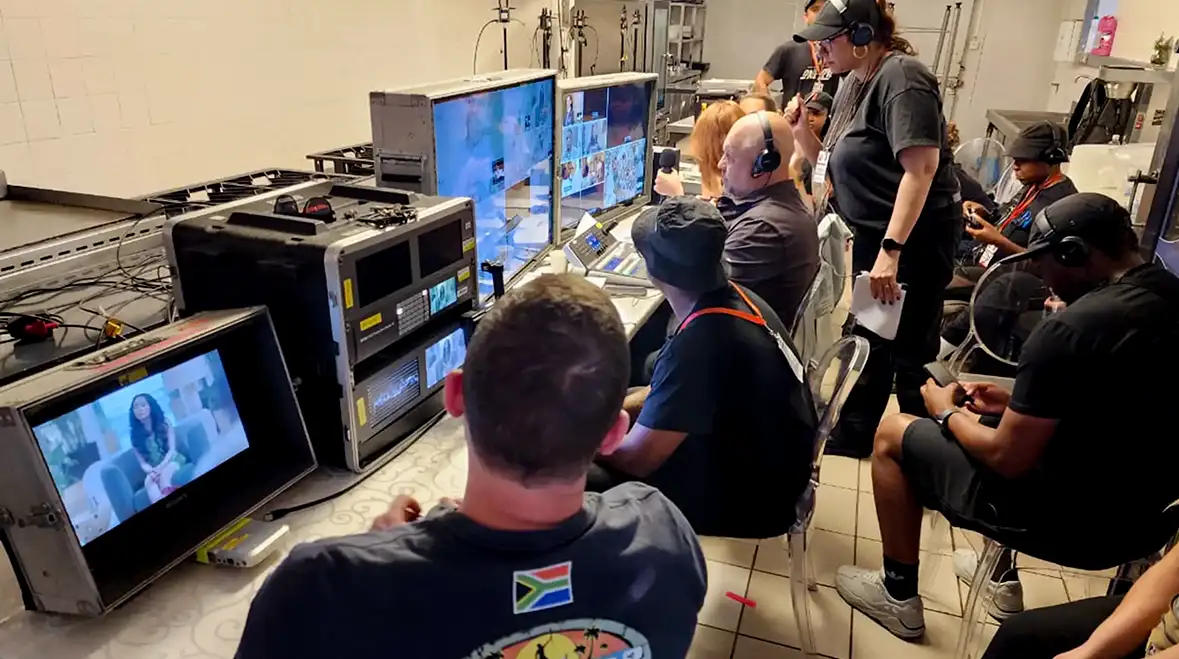
Once cameras are deployed, signals need to reach production reliably. Directors and technical teams need to monitor multiple feeds, recordings need to be protected, and the workflow needs to allow for fast intervention when problems appear. The better the routing and control design, the smoother the shoot will feel to the production team.
Placeholder link for future articles
A major engineering challenge in reality production is distance. Productions are often spread across camps, estates, lodges, outdoor locations or multi-zone sets where cameras and control areas are far apart.
That is why long-distance signal transport and wireless design are so important. Fibre often becomes essential when runs are too long for copper, while wireless systems must be carefully matched to the terrain and the production objective.
Tom cites The One as a good example of technical problem solving under pressure. The production required significant wireless distance, and while a bonding solution would ideally have been used, the team still delivered the job with DJI SDR wireless units across more than four kilometres. This is the kind of pragmatic engineering capability that reality productions depend on.
Placeholder link for future articles
Media handling is one of the most overlooked parts of Reality TV engineering, yet it has a direct effect on speed, risk and editorial confidence. Large reality productions generate substantial footage volumes, and weak data processes can create lost files, delays or handover confusion.
Tom explains that Visual Impact has increasingly moved toward network-based data management because physical SSD handoffs create more points of failure. Files can be missed, drives can fail, and manual handling adds risk. A network-based approach is faster, more efficient and safer when designed properly.
Roedolph adds concrete technical detail, noting that Visual Impact uses Blackmagic Cloud Store units with up to 144 terabytes of storage on a 10 Gig network. This shows that the workflow is not theoretical. It is already built around shared, high-capacity storage designed to keep production data moving quickly and reliably.
Tom also highlights the importance of forecasting expected data volumes upfront and setting media sign-off cycles with the client. Rather than sitting on footage indefinitely, the goal is to secure sign-off regularly so media can be cleared, formatted and recycled in an orderly way. This is an excellent example of how engineering and editorial workflow need to work together.
Placeholder link for future articles
The strongest competitive message in all the source material is simple: many companies rent equipment, but Visual Impact engineers workflows.
That differentiation shows up at several levels. The company begins with practical producer discovery rather than pushing standard kits. It then designs around the exact needs of the production, prepares and tests systems in advance, supports the workflow on set, and handles media strategy as part of the overall solution.
Tom adds that Visual Impact can often repair equipment on production to reduce downtime, while Roedolph points to the availability of Sony-certified engineering support when needed. Combined with the bespoke design approach, that makes Visual Impact much more than a rental vendor. It positions the company as a technical partner for complex reality formats.
Placeholder link for future articles
The strongest current example is I’m a Celebrity… Get Me Out of Here. Tom describes a camp with 18 cameras located roughly one kilometre from MCR, with content needing to be shot, edited and delivered live to another country every night for 21 days. That kind of workflow places sustained pressure on acquisition, routing, monitoring, recording and delivery at the same time.
Roedolph references Love Island SA as a project where Visual Impact’s technical contribution was crucial to getting the show to air. Even without expanding every detail publicly, it reinforces the company’s track record in high-pressure reality environments.
Tom also mentions a Dutch reality project that required complex DMX based lighting choreography, and The One, where the team solved a long-range wireless problem that could easily have derailed the production. These projects all support the same message: reality TV success depends on experienced engineering, not just a list of supplied products.
Placeholder link for future articles
The next phase of reality production is likely to become even more network-centric. Tom sees the future in doing more and more of the workflow over networked systems, reducing dependence on physical media and eventually pushing more functionality into wireless environments as bandwidth and cost improve.
He also points to network-based data systems, wireless camera control and more connected control infrastructure as practical future directions. These are highly relevant because they build on the needs productions already face today.
Roedolph adds broader industry shifts, including real-time audience interaction, immersive viewing possibilities, metaverse or VR participation, and LED volumes in some formats. Whether every show adopts these ideas immediately or not, the trend is clear: reality workflows are becoming more technologically layered, not less.
When Reality TV is done well, the audience sees stories, personalities and tension. What they do not see is the engineered system that keeps the production functioning across cameras, control, routing, wireless transmission, media handling and rapid problem solving.
That hidden system is where Visual Impact creates value. The company’s approach begins with scoping the real needs of the production, continues through tailored technical design and pre-production testing, and carries through to on-set support and data management. In a category where failure is expensive and unpredictability is constant, that depth of engineering matters.
For producers, that means a stronger workflow, fewer technical surprises and a better chance of capturing the story without disruption. For Visual Impact, it is the clearest possible authority position: not just equipment rental, but engineered reality television production support.
It depends on the format, but larger reality productions may require anything from a small roaming package to dozens of cameras. Visual Impact notes that some shows can scale to around 50 cameras depending on coverage needs, fixed rig positions and editorial requirements.
PTZ cameras allow productions to place remotely controlled cameras in positions where operators may not be practical. They are especially useful on long running reality setups, multi zone environments and locations where discreet, repeatable coverage is important.
A strong workflow combines reliable recording, network based storage, planned media handoff cycles and clear client sign off. Visual Impact increasingly uses network based media management to reduce handling risk and speed up access to footage.
Engineering connects the whole system. It covers signal flow, camera control, monitoring, routing, wireless planning, data management, dry runs, fault response and technical support throughout the production.
Long distance transmission often relies on careful fibre and network planning, with wireless systems used where mobility is needed. The right balance depends on distance, terrain, signal stability and the speed at which footage or live feeds need to move.
Email: reality@visuals.tv
Call: 021 468 6000

Visual Impact South Africa is one of the largest broadcast and film equipment rentals, sales and service companies in South Africa. As part of the international Visual Impact group of companies, we have access to a wide range of equipment and in-house technical expertise.
Visual Impact South Africa, with offices in Johannesburg and Cape Town, provides broadcast and production equipment rentals, workflow solutions, and technical support across Africa, including mobile editing and data management services. The company represents leading global brands such as Sony, ARRI, RED, Canon, and Blackmagic Design, and has facilitated major reality TV productions like I’m a Celebrity, Idols SA, MasterChef SA, and The Bachelor Germany.
Follow Us