A Day in the Life Working on a VR Production
15 Oct, 2025


2025 Copyright @ Visual Impact.
All Rights Reserved
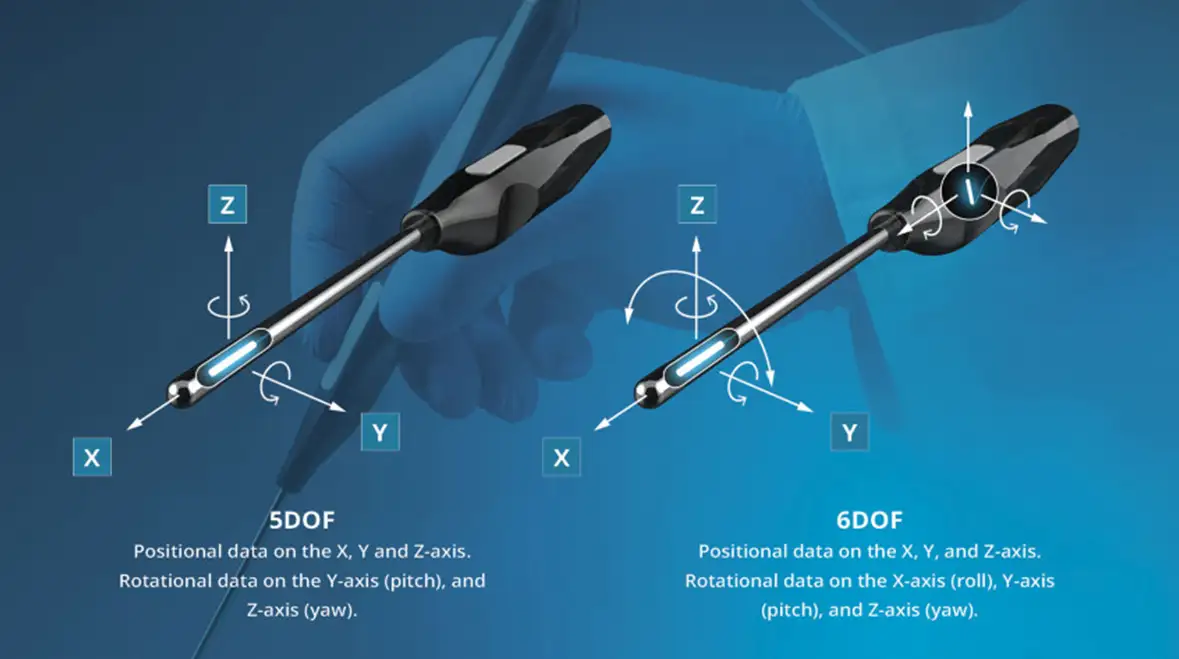
6DOF stands for six degrees of freedom, and it refers to the ability of an object or system to move in six different directions. These directions are typically defined as three linear movements (up/down, left/right, forward/backward) and three rotational movements (pitch, yaw, and roll). As a global leader in electromagnetic (EM) navigation, one of NDI's specialties is researching and designing 5 (Degrees of Freedom) DOF and 6DOF sensor technology used in EM tracking systems.
The distinction between 5DOF and 6DOF sensors is critical to enhancing the accuracy and control of medical instrument navigation within the body. In this article, we'll explore the differences between these sensor types, situations that may require one over the other, and how our expert integration team supports customers with different sensors based on their unique medical device needs.
Degrees of freedom (DOF) represent the number of independent ways an object can move in space. In the context of electromagnetic tracking systems, this determines how precisely we can track and navigate medical instruments during procedures. The more degrees of freedom a sensor can detect, the more accurate and comprehensive the tracking becomes.
5DOF sensors track five degrees of freedom: three translational (X, Y, Z position) and two rotational (pitch and yaw). These sensors provide position information and partial orientation, making them suitable for applications where complete rotational tracking isn't necessary or where cost optimization is a priority. 5DOF sensors are often used in situations where the device being tracked has a constrained or predictable rotation.
6DOF sensors track all six degrees of freedom: three translational movements (X, Y, Z position) and three rotational movements (pitch, yaw, and roll). This provides complete position and orientation tracking, offering the highest level of accuracy and control for medical instrument navigation. 6DOF sensors are essential when precise orientation tracking is critical for the success of a procedure.
The distinction between 5DOF and 6DOF sensors is critical to enhancing the accuracy and control of medical instrument navigation within the body.
The choice between 5DOF and 6DOF sensors depends on several factors, including the specific medical application, the type of instrument being tracked, the required level of precision, and budget considerations. For procedures requiring complete spatial awareness and orientation control, 6DOF sensors provide the comprehensive tracking needed. However, for applications where orientation constraints exist or cost is a factor, 5DOF sensors may offer a suitable alternative.
Electromagnetic tracking systems with 5DOF and 6DOF sensors play a crucial role in various medical applications, including surgical navigation, interventional radiology, and image-guided procedures. These systems enable clinicians to precisely track instruments within the body, providing real-time position and orientation data that enhances procedural accuracy and patient safety.
As a global leader in electromagnetic navigation, NDI's expertise in 5DOF and 6DOF sensor technology ensures that medical device manufacturers and healthcare providers have access to the most advanced tracking solutions available. Our integration team works closely with customers to determine the optimal sensor configuration for their specific medical device needs.
If you're interested in learning more about 6DOF and how these sensors work in electromagnetic tracking systems, please see the resource below.
Link: https://www.ndigital.com/6dof-explained/
Visual Impact South Africa is one of the largest broadcast and film equipment rentals, sales and service companies in South Africa. As part of the international Visual Impact group of companies, we have access to a wide range of equipment and in-house technical expertise.
Visual Impact South Africa, with offices in Johannesburg and Cape Town, provides broadcast and production equipment rentals, workflow solutions, and technical support across Africa, including mobile editing and data management services. The company represents leading global brands such as Sony, ARRI, RED, Canon, and Blackmagic Design, and has facilitated major reality TV productions like I'm a Celebrity, Idols SA, MasterChef SA, and The Bachelor Germany.
Follow Us