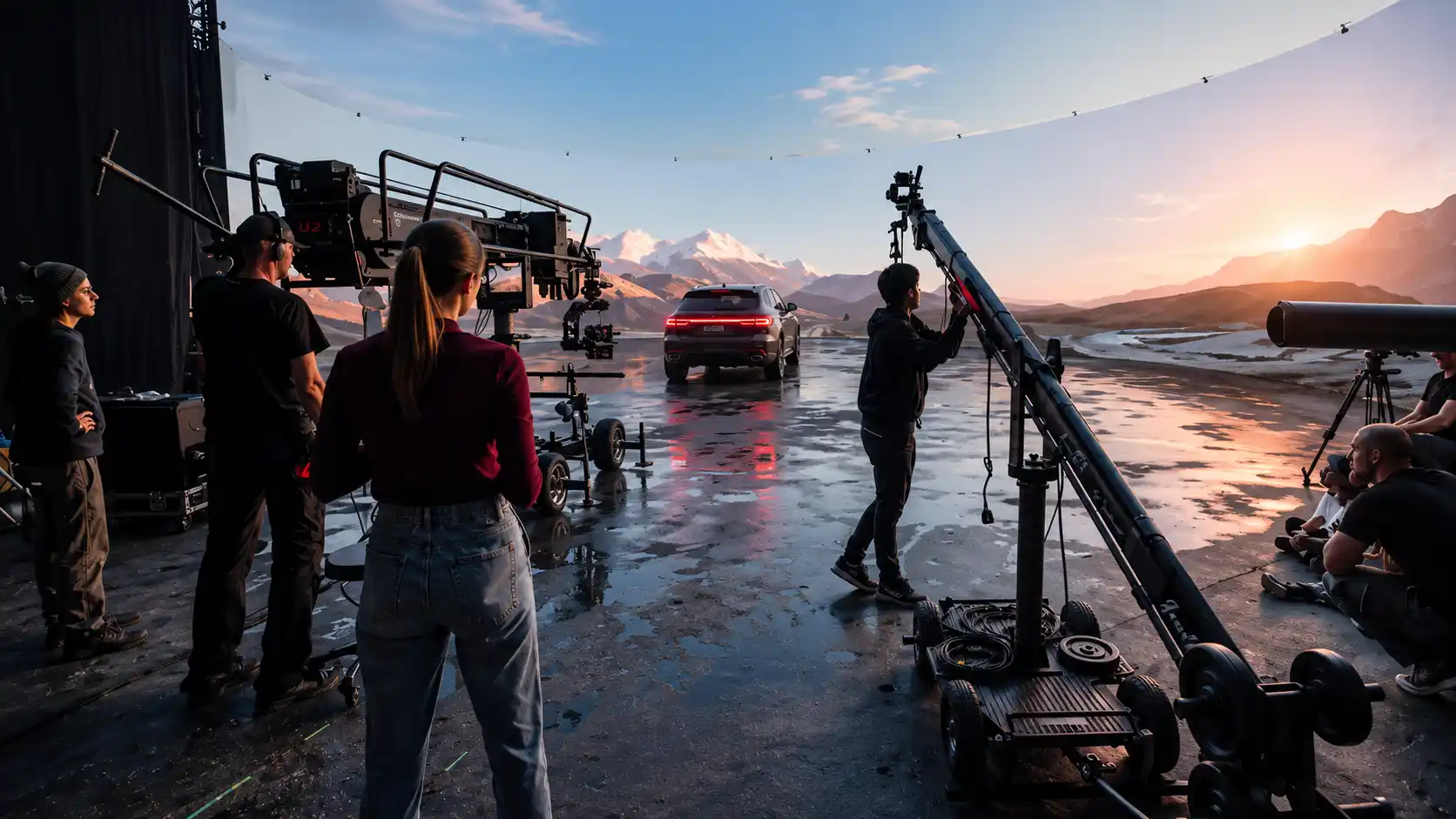
For most of broadcast history, the set was simply the set. You built, lit, dressed, and shot it, and whatever the camera saw was what existed. Virtual production unsettles that equation.
The background, the lighting interaction, even the camera move, can now be generated in real time and tracked precisely enough to convince an audience it was always physically there.
Visual Impact has built one of the more comprehensive virtual production capabilities on the continent by bringing together broadcast engineering, real-time rendering, and motion tracking under one roof.
Three Technologies, One Stage

A virtual production stage only works if three separate systems agree with each other, continuously, in real time. A rendering engine has to generate the virtual environment. A tracking system has to tell that engine exactly where the physical camera is in space, frame by frame. And broadcast-grade signal infrastructure has to move all of that data without a single frame of latency creeping in, because the moment it does, the illusion collapses.
Visual Impact's VR/XR studio pairs Zero Density's real-time rendering with OptiTrack motion tracking, wrapped in the same broadcast engineering discipline that underpins every rental and systems integration project the company takes on. None of the three pieces is especially hard to source on its own. What's hard, and what actually constitutes the offering, is making them agree with each other reliably enough that a production can trust the stage with a live broadcast.
Not Just for Broadcast Anymore

The same motion-tracking core that puts a weather presenter in front of a virtual map turns out to be useful for industries that have nothing to do with broadcasting at all: biomechanics research, robotics engineering, product animation, and location-based VR experiences. It's one infrastructure investment doing work across several unrelated markets, which is a large part of why it makes sense as a shared studio resource rather than something every individual production tries to build from scratch.
Why This Matters for South African Productions
Virtual production has, until fairly recently, meant flying a crew and a budget to one of a small number of international stages. A locally accessible VR/XR studio changes that calculation on both sides.
Local productions get access to the same tools without the logistics and cost of an international build. International productions get a capable African base to work from, rather than none at all.
That shift is worth percolating with. It isn't simply a convenience; it changes which productions can realistically consider virtual production in the first place, and which remain priced out of it.
This is deliberately the wide-angle view of what the studio does; a closer look at how the motion-tracking side of the work actually functions, and what it takes, practically, to get a production onto the studio floor.
Productions curious whether virtual production fits their next shoot are welcome to talk it through with Visual Impact's VR/XR studio team.
Stay Informed with
Top Headlines